
Political Puzzle Pieces: Examining the Redrawing of the North Carolina Congressional Map
By Verity Morgan ‘27
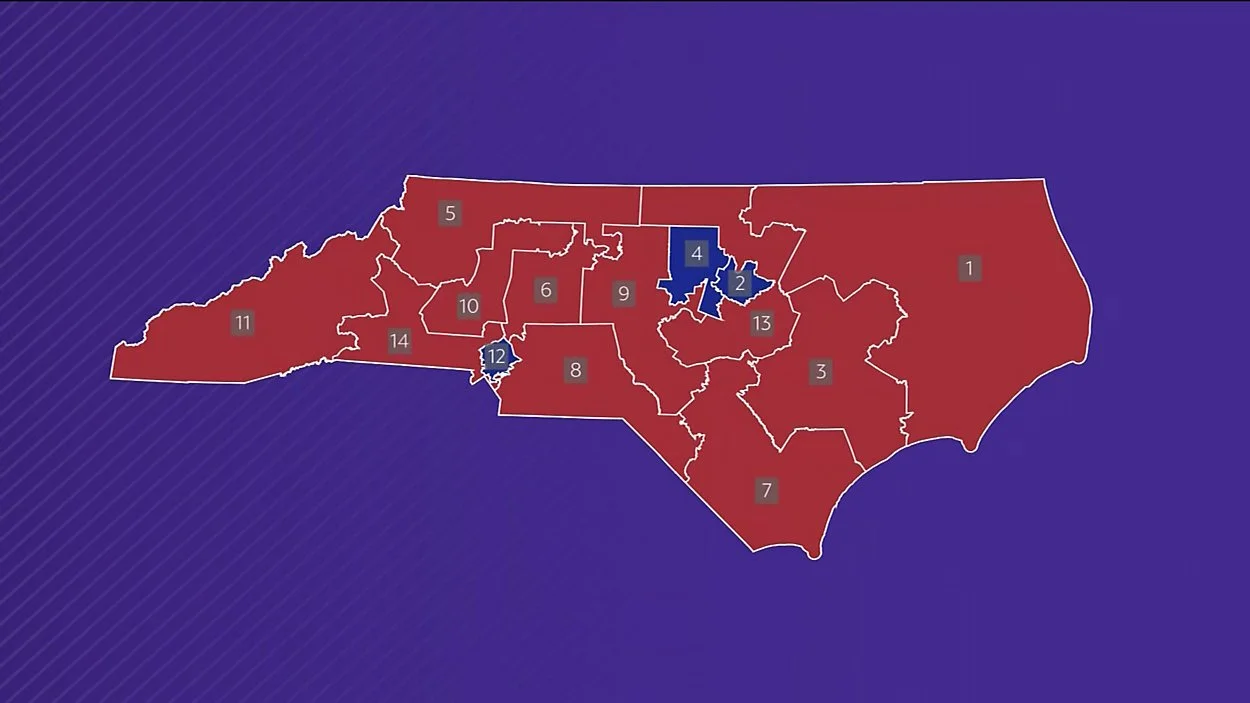
For the United States system of government to function, representatives must be elected into office. As generations tick by, political majorities and minorities will fluctuate due to the values that the population would like to be prioritized. That is the foundational point of democracy in the United States. For the values of the population and the respective representatives to be properly installed in the United States Government, district maps will be drawn. These maps are typically drawn based on data provided by the U.S. Census, and legislation can be proposed within the respective state Senate to redraw district maps before the census. That is exactly what happened with North Carolina Senate Bill 249. North Carolina Senate Bill 249 was introduced to the North Carolina Senate floor in early October of 2025 by North Carolina Senator Alexander Daniel. Proposing the redrawing of the North Carolina congressional map to shift the map into most likely guarantee the republican party four more congressional districts. Giving the republican party eleven congressional representatives and the democratic party three congressional representatives.
Within the United States House, North Carolina has fourteen representatives. In a historic election season during the 2022 midterms, the political affiliation split was even. Seven Democratic representatives and seven Republican representatives. Solidifying North Carolina as a prominent swing state in the 2024 presidential election. However, due to the ratification of North Carolina Senate Bill 249 into law, the equality of representation for North Carolinians in Congress is at risk of coming to an end with the 2026 midterm elections.
Congressional districts across the United States are drawn based on the population data recorded by the United States Census that occurs every ten years. However, some states do occasionally partake in a legal redrawing of maps after five years. The motives as to why a state legislature might choose to redraw maps after five years can be speculated for various reasons. Often, maps are redrawn early based on a state's own population survey, to compensate for any possible discrepancies in population size collected in the United States Census. Based on the United States Supreme Court decision in the Wesberry v. Sanders case, congressional maps must be drawn so that each district has the same number of potential voters. This is to align with the doctrine of ‘one person one vote’ that the Wesberry v. Sanders ruling introduced.
This doctrine was accepted on the foundational principle of keeping local and national elections as unbiased and fair as possible. However, congressional maps under the doctrine of ‘one person, one vote’ can be manipulated. Congressional district maps can be manipulated in one of two ways. A congressional district can be cracked or packed depending on the situation. If a congressional district is ‘cracked,’ then the map is drawn to split a congressional district and redraw it so that the district is absorbed or isolated by other districts on the congressional map. If a congressional district is ‘packed’, then the map is drawn to force a large population of voters of a single party to create, for lack of a better term, a safe district for a certain party. Because of an overwhelming majority of a single party in a district, that district is nearly guaranteed to vote for a certain candidate. The practice of manipulating congressional districts to favor a certain political party or candidate is called gerrymandering.
The practice of gerrymandering is illegal in the United States, as it goes against the constitutional rights granted to American citizens in the 13th, 14th, and 15th amendments. However, the actual act of the gerrymander is extremely hard to prove in a court of law. Because of this, within United States history, primarily in the 20th and 21st centuries, there have been a few infamous cases of gerrymandering or cases that were a hair's breadth away from being considered gerrymandering. The most relevant to the North Carolina Senate Bill 249 is the striking of a previous North Carolina congressional map redrawing. In the case of Moore v. Harper in 2023, the United States Supreme Court reviewed a case that was dismissed as unconstitutional partisan gerrymandering by the North Carolina Supreme Court. The North Carolina legislature argued that the ruling by the North Carolina Supreme Court had no grounds due to the Election Clause in the United States Constitution. It was argued that the Election Clause gave the legislature the right to make decisions without the oversight of the governor and state courts. The United States Supreme Court disagreed and, in a six-to-three decision, backed the North Carolina Supreme Court.
Despite the heated history of gerrymandering within North Carolina in October of 2025, the North Carolina State Senate Bill 249 passed at a twenty-five to twenty majority. North Carolina Senate Bill 249 redraws the congressional map of North Carolina to shift ten out of the fourteen congressional districts. Moving congressional lines across counties in a way that is similar to a jigsaw puzzle. Furthermore, what is unusual for the North Carolina Senate Bill 249 is the treatment of the first congressional district. As previously stated, congressional maps can be redrawn in an effort to ‘pack’ or ‘crack’ a district. That appears to be the case in the first congressional district of North Carolina. The first district, upon examination and comparison, was ‘cracked’. North Carolina Senate Bill 249 redrew and removed six full counties from the first congressional district and reallocated them to the third congressional district, effectively splitting the first congressional district in half.
The redrawing of congressional maps due to Bill 249 is theorized by many experts and activist groups to target specifically African American voters in North Carolina. The first congressional district of North Carolina has, for years, had a regular, significant turnout of African American voters. Additionally, the first congressional district has historically voted for democratic candidates for decades. The current representative– and the incumbent candidate for reelection– Donald Davis, a democrat, has served for two terms already. However, due to the redrawing of the congressional maps, Representative Davis might face a tough run for reelection in the upcoming 2026 midterm elections.
Due to these factors, many racial advocacy groups and democratic associations across North Carolina have protested the passage of Senate Bill 249 into law. A few activist groups, such as the North Carolina State Conference of the NAACP, launched a formal complaint against the North Carolina Senate back in November of 2025. The complaint is on the basis that Bill 249 is retaliatory in nature. Accusing the North Carolina Senate of purposely targeting the first and third congressional districts, due to the aforementioned voter demographics and voting patterns. However, the complaint was dropped as of January 2026 after the sponsors of the complaint rescinded. Once taken to court, a North Carolina judge dismissed the filing on the grounds of lack of hard evidence and not in true violation of the Fourteenth Amendment, as the complaint described.
Overall, North Carolina Senate Bill 249 has changed the political landscape of North Carolina in an immeasurable way. As another addition to a long history of possible cases of gerrymandering throughout the United States, even after the rulings of court cases such as the United States Supreme Court ruling in Wesbury v. Sanders. With the North Carolina first congressional district being split and the respective counties being shifted and reallocated to the third congressional district. Shifting the once evenly split, seven-to-seven, North Carolina congressional map to one of a heavy majority favoring the Republican Party. With the 2026 Midterm around the proverbial corner, and any descent against North Carolina Senate Bill 249 dropped, the outcomes of the respective elections are sure to be interesting and impactful.
Verity Morgan is a junior majoring in political science and criminal justice.
Sources
Bloomberg Industry Group. 2025. “Congressional Redistricting,” February 10, 2025, Bloomberg Government. https://about.bgov.com/insights/congress/who-draws-congressional-districts/.
Carolina Journal Staff. 2026. “NC congressional map critics drop federal lawsuits,” January 20, 2026. The Carolina Journal, January 20, 2026. https://www.carolinajournal.com/nc-congressional-map-critics-drop-federal-lawsuits/#:~:text=CJ%20Staff,with%20the%20current%20congressional%20map.
Dillon, A. P. 2025. “Legal challenge filed over new election maps.” North State Journal, November 6, 2025. https://nsjonline.com/article/2025/11/legal-challenge-filed-over-new-election-maps/.
Eckman, Sarah J. 2025. “Congressional Redistricting Criteria and Considerations | Congress.gov | Library of Congress.” Congress.gov. https://www.congress.gov/crs-product/IN11618.
Guest, Olivia, Frank J. Kanayet, and Bradley C. Love. 2019. “Gerrymandering and computational redistricting.” National Library of Medicine 2, no. 2 (August): 119-131. https://doi.org/10.1007/s42001-019-00053-9.
Larson, David. 2026. “5 NC races to watch as the 2026 primaries wrap up.” Carolina Journal, February 20, 2026. https://www.carolinajournal.com/opinion/5-nc-races-to-watch-as-the-2026-primaries-wrap-up/.
Latino Policy & Politics Institute Staff. 2020. “Redistricting Criteria and Legal Requirements | Latino Policy & Politics Institute.” Latino Policy & Politics Institute. https://latino.ucla.edu/redistricting-criteria-and-legal-requirements/.
Levitt, Justin. 2020. “Who draws the lines? - All About Redistricting.” About Redistricting. https://redistricting.lls.edu/redistricting-101/who-draws-the-lines/.
Li, Michael, Peter Miller, and Gina Feliz. 2023. “Anatomy of a North Carolina Gerrymander.” Brennan Center for Justice. https://www.brennancenter.org/our-work/analysis-opinion/anatomy-north-carolina-gerrymander.
National Conference of State Legislature Staff. 2025. “Report Redistricting and the Supreme Court: The Most Significant Cases.” National Conference of State Legislatures. https://www.ncsl.org/redistricting-and-census/redistricting-and-the-supreme-court-the-most-significant-cases.
North Carolina State University Department of History Staff. 2019. “Drawing Democracy: North Carolina’s Gerrymandering History.” NC State Department of History. https://history.chass.ncsu.edu/2019/07/29/drawing-democracy-north-carolinas-gerrymandering-history/#:~:text=The%20Voting%20Rights%20Act%20allowed,the%201990s%20to%20the%20present.
Petersen, Christian. 2025. “North Carolina State House passes redistricting bill into law.” WXII, October 22, 2025. https://www.wxii12.com/article/north-carolina-state-house-passes-redistricting-bill-law/69127335.
Wagner, Adam, and Colin Campbell. 2025. “NC Senate advances new Congressional map intended to pick up an additional GOP seat.” WUNC, October 20, 2025. https://www.wunc.org/politics/2025-10-20/nc-senate-congressional-map-additional-gop-seat.
