
March 26, 2026
Roper v. Simmons, 543 U.S. 551 (2005)
By KJ Obeng ‘29
Introduction:
Roper v. Simmons, decided on March 1st, 2005, would alter how juveniles were to be seen in accordance with the death penalty in America forever. The Eighth and Fourteenth Amendments to the United States Constitution, ratified in 1791 and 1868, respectively, work to ensure that no state can enact laws that place American citizens at a legal disadvantage or impose unusually harsh consequences. In Roper v. Simmons, the main argument facing the Supreme Court of the United States was whether the death penalty, when imposed upon citizens under the age of eighteen, violates the rights of these juveniles.
Facts of the case:
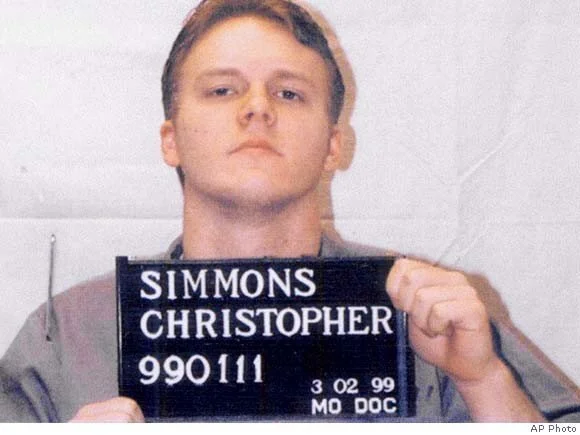
Previously involved in a car crash, 17-year-old Christopher Simmons, with 16-year-old John Tessmer and 15-year-old Charles Benjamin, decided he wanted to “murder someone,” with Shirley Crook, the other person involved in the crash, being the premeditated victim. Under the cover of night, the 3 boys would break into and enter the Crook residence, then proceed to tie her eyes, mouth, and arms up with duct tape, and kidnap her in a van to a state park. At the state park, Crook was then taken to a railroad and re-tied in electrical wire; this time, her whole head was wrapped in duct tape. Only then would the boys throw her off a bridge and into the waters of the Meramec River, where she drowned.
Crook's husband, Steven Crook, would return home soon after and report his wife missing, only for fishermen to recover her body from the river that same day. Within the next few days, police eventually traced the homicide back to Simmons, who had been bragging to friends about the act. At the police station, Simmons confessed to the crime and was promptly charged with several charges, including burglary, murder, and kidnapping, all in the first degree. Due to his age being past the confines of the juvenile courts, the 17-year-old was tried as an adult, and the jury submitted a guilty verdict, allowing the State of Missouri to seek the death sentence as a penalty. In Missouri, male death row inmates are held in the Potosi Correctional Center, where, at the time, Donald P. Roper served as the facility’s superintendent. This death sentence penalty placed upon Simmons would climb through to the Missouri Supreme Court, which deemed the ruling unconstitutional, leading Roper v. Simmons to land on the desk of the United States Supreme Court.
Who was making the decision:
At the time of Roper v. Simmons, the acting President of the United States was George W. Bush, and the Supreme Court Chief Justice was William H. Rehnquist, the 16th Chief Justice, best known as an exceptional and even-tempered leader. Before the case, Rehnquist had served as the chief justice in key proceedings, most notably presiding over the Senate’s impeachment trial of Former President Bill Clinton in 1999. He also played a significant role in Nevada Department ofHuman Resources v. Hibbs two years earlier, a case that allowed state employees to sue their employers under the Family and Medical Leave Act. For this case, Chief Justice William Rehnquist was joined by justices John Paul Stevens, Sandra Day O’Connor, Antonin Scalia, Anthony Kennedy, David H. Souter, Clarence Thomas, Ruth Bader Ginsburg, and Stephen G. Breyer.
Constitutional issue:
Rehnquist’s Court had one large question before it: Does the State have the power to impose the death penalty on juveniles under the guidelines of the Constitution? In objection to the death penalty, the defense referred to his age, 17, claiming that the defendant was “very immature, impulsive, and susceptible to being manipulated or influenced.” The plaintiff’s counsel also made use of Simmons’ age, but instead “argued [that] Simmons’ youth [was] aggravating rather than mitigating.” By this, the counsel’s counterargument was that such a crime carried out by an individual of Simmons’ age was an aggravating factor, or a factor that would warrant more severe consequences, rather than a mitigating factor, which would find him less culpable for the crime.
The Constitution, through the Eighth Amendment and Section 1 of the Fourteenth Amendment, protects citizens from “excessive bail, fines, and cruel and unusual punishment,” as well as protection from state laws that may “deprive [one] of life, liberty, or property, without due process of law.” In Roper v. Simmons, these crucial pieces of legislation intended to present the proposed death penalty as a “cruel and unusual punishment,” which could not be carried out by the State of Missouri due to the Fourteenth Amendment’s limit on the state’s ability to impose such punishment. Within these bounds, Chief Justice Rehnquist and the Supreme Court of the United States intended to reach a decision that would resolve Roper v. Simmons.
The decision:
Rehnquist’s Court concluded the case with a 5-4 majority decision in favor of Simmons. For the majority’s opinion for the ruling, Justice Anthony Kennedy wrote that the State of Missouri could “exact forfeiture of some of the most basic liberties of [juvenile offenders], but could not extinguish his life and his potential to attain a mature understanding of his own humanity.” The Court concurred with the defense, also sharing the sentiment that Simmons’ age made him immature, and therefore less liable for the crime than an adult would have been. Another point added by Justices Stevens and Ginsburg was “if the meaning of the [Eighth Amendment] had been frozen when it was originally drafted, it would impose no impediment to the execution of 7-year-old children today,” determining that the Eighth Amendment has developed with society. If it had failed to evolve since its origin, a seven-year-old would be executed today, as they were in the 1700s.
Another factor the majority found compelling was that of the 50 states, 30 prohibited the execution of the death penalty on juveniles. This number counts 12 states that have outlawed the death penalty altogether. On the concept of 12 states having banned the penalty, the Court dictated that “a State’s decision to bar the death penalty altogether of necessity demonstrates a judgment that the death penalty is inappropriate for all offenders, including juveniles.” Not only did the Eighth and Fourteenth Amendments play a role in the final verdict, but the example of other States is not to be overlooked.
The dissenting Justices of O’ Connor, Scalia, Thomas, and Rehnquist believed that certain matters, like the minimum age for the death penalty, were a decision for the State Legislature, not the Supreme Court. Along with this, the Court argued that “evidence of a national consensus” against the death penalty was not enough support for a complete abolishment of the death penalty for minors. Furthermore, the dissenting opinion criticized the Missouri Supreme Court majority for not adhering to precedent, which in this case was the ruling of Stanford v. Kentucky (1989), the Supreme Court decision that had specifically permitted the execution of citizens aged 16 and beyond.
Impact today:
The verdict reached in Roper v. Simmons would forever change how the United States justice system viewed the death penalty for juveniles under the age of 18. In early March of 2005, when the Supreme Court declared the execution of death row juveniles illegal, 72 juvenile offenders in 12 states would have their sentences immediately commuted. Roper v. Simmons cemented the stark distinction between adult and juvenile accountability in the courts and set a precedent for subsequent cases on juvenile accountability, including Graham v. Florida (2010) and Jones v. Mississippi (2021). Whenever a juvenile faces the consequences of a crime, this case will serve as a foundation for the final ruling, defining the boundaries between child and adult in the legal sphere.
KJ Obeng is a freshman majoring in philosophy.
Sources
Death Penalty Information Center. “Roper v. Simmons Resource Page.” https://deathpenaltyinfo.org/policy-issues/policy/united-states-supreme-court/significant-supreme-court-opinions/roper-v-simmons-resource-page
Roper v. Simmons, 543 U.S. 551 (2005)
"Roper v. Simmons." Oyez. Accessed March 14, 2026. https://www.oyez.org/cases/2004/03-633
Rovner, Joshua. “Juvenile Life Without Parole: An Overview.” The Sentencing Project. April 7, 2023. https://www.sentencingproject.org/policy-brief/juvenile-life-without-parole-an-overview/
Schultz, David. “William Rehnquist.” Free Speech Center, July 9, 2024. https://firstamendment.mtsu.edu/article/william-rehnquist/
U.S. Const. amend. VIII, XIV § 1.
"William H. Rehnquist." Oyez. Accessed March 14, 2026. https://www.oyez.org/justices/william_h_rehnquist