
Dying Without Choice: The Eighth Amendment’s Blind Spot
By Avery Sneed ‘26
Introduction
On October 23, the Supreme Court declined a request from an Alabama inmate to block his execution, which was scheduled for that day. In an unsigned order, the justices denied Anthony Boyd’s plea to stay his execution and to decide whether death by nitrogen hypoxia would trigger the Eighth Amendment’s cruel and unusual punishment protection. Boyd, convicted of a 1993 murder, requested to die by firing squad instead. Boyd was executed by nitrogen hypoxia later that day. Boyd’s case presented a dire question before the nation’s highest court. When the state decides to end someone’s life, does the Eighth Amendment entitle that person to avoid unnecessary pain by choosing an alternative method? Although the Court declined to intervene, the case underscores a broader constitutional issue. Does the Eighth Amendment merely forbid ancient, barbaric punishments? Or does it provide death row inmates with some discretion to choose the least cruel method available? On the other hand, does the Constitution provide the state with full authority over its decision to execute, and how?
Historical Background: Cruel and Unusual Punishments
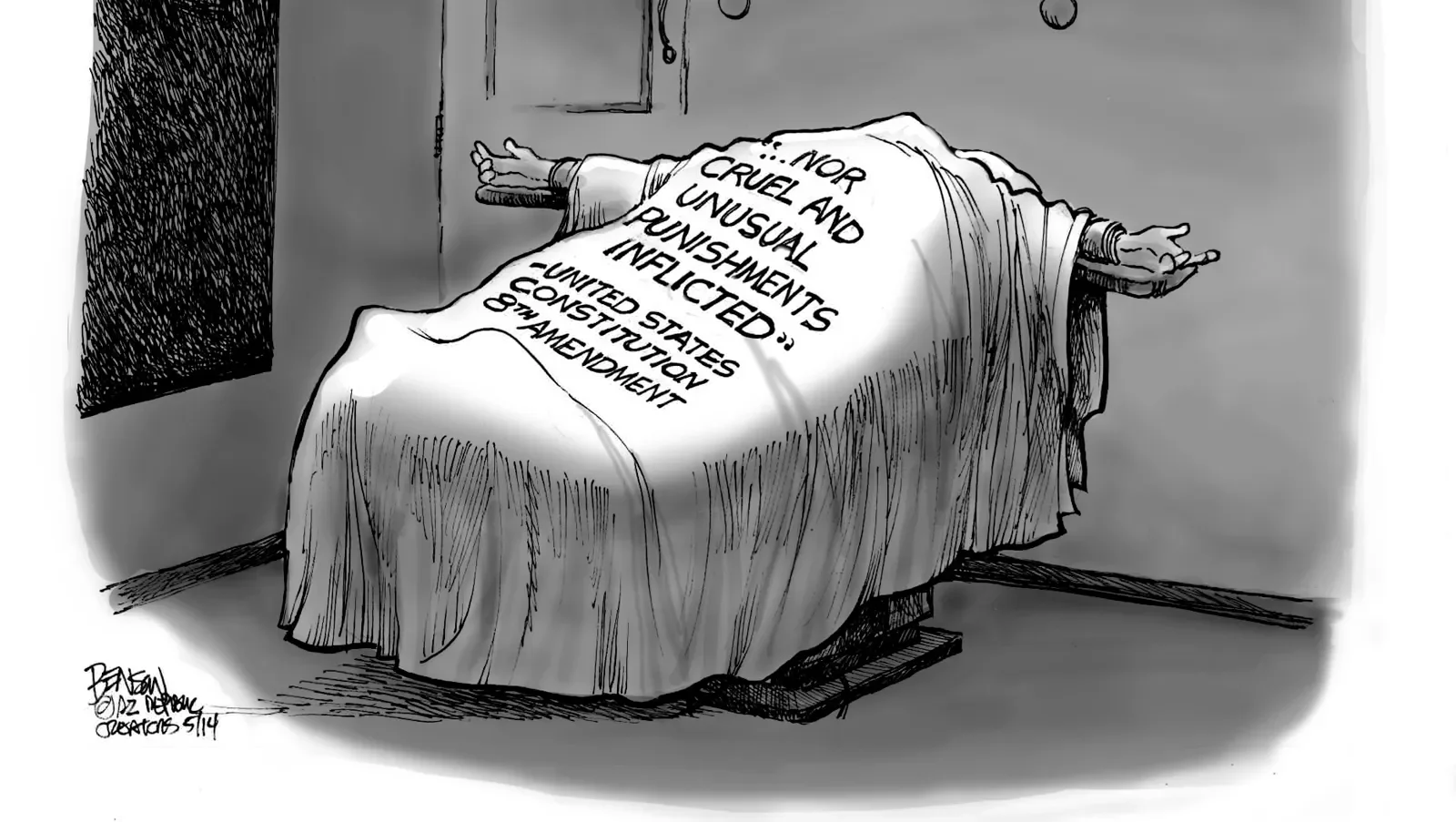
The Eighth Amendment, among other things, provides that “cruel and unusual punishments” shall not be inflicted. Ratified in 1791, this provision finds its roots in the English Bill of Rights of 1689, and was originally intended to prohibit both physically torturous punishments and those that are disproportionate or arbitrary in their imposition. The phrasing of the provision is rather broad, and thus, “cruel and unusual” has never been static in meaning. In the 19th century, the Supreme Court would offer the first glimpse into Eighth Amendment jurisprudence. In Wilkerson v. Utah (1878), the Court upheld death by firing squad, holding that the punishment did not constitute cruel and unusual punishment. The Court did, however, clarify what would fall under that category. The Court reasoned that “punishments of torture,” including the old English practices of live disembowelment, beheading, and quartering, are “forbidden by that amendment to the Constitution.” This early precedent set a high bar for what constituted cruel and unusual punishment, focusing strictly on methods that shocked the conscience in their brutality.
Throughout the 20th century, the Court would adopt a more fluid interpretation of the Eighth Amendment. In Trop v. Dulles (1958), the Court held that revoking citizenship as the punishment for a crime is akin to cruel and unusual punishment. Writing for the majority, Chief Justice Earl Warren wrote that “the amendment must draw its meaning from the evolving standards of decency that mark the progress of a maturing society.” The Court’s new approach would transform Eighth Amendment jurisprudence by acknowledging that what may have been acceptable in the past could become impermissible as society’s moral compass evolves. The decision in Trop would lay the foundation for considering not only the severity of the punishment, but also the method in which it was carried out. The question was no longer if the punishment was historically acceptable, but whether it would conform with the decency of modern society.
The Modern Era
As lethal injection began to replace older methods, such as hanging, electrocution, and gas chambers, disputes over humaneness once again invoked questions regarding the Eighth Amendment’s language. In a string of cases, the Supreme Court set forth a framework that governs nearly every contemporary method-of-execution challenge. The beginnings of questioning whether a certain method needlessly adds pain came in Baze v. Rees (2008). In Baze, Kentucky prisoners challenged the state’s three-drug sequence, arguing that the concoction risked agony if the sedative were to fail. Chief Justice Roberts delivered the Court’s plurality opinion, in which a two-part was laid out. First, a prisoner must prove that a state’s procedure would inflict a “substantial” or “objectively intolerable” risk of serious harm, not a speculative one. Even if the first part of the test is satisfied, the challenger still must demonstrate that the state could’ve identified and implemented a “feasible alternative” that would significantly reduce the risk of unnecessary pain. The Court stressed that some sort of pain is inevitable with any execution, and the “Constitution does not demand the avoidance of all risk of pain.” Although the challenge to Kentucky’s execution practice was denied, the Baze decision offered a new perspective into cruel and unusual punishment challenges: is needlessly superadded pain considered cruel and unusual punishment?
Seven years later, Oklahoma’s use of the sedative midazolam ignited new challenges after several visibly botched executions. In the case of Glossip v. Gross, the Court reaffirmed, and strengthened, the Baze test. The Court held that an inmate cannot prevail without proposing a specific, known, and available alternative method that would substantially reduce the risk of severe pain. Because the petitioners had not done so and could not show midazolam’s risk was greater than other available drugs, their claim failed. Glossip transformed the alternative method requirement from a consideration into a gatekeeping rule. Absent an alternative, the courts will not even consider the merits of an Eighth Amendment method challenge. The decision signaled the Court’s reluctance to challenge state protocols, opting to let federalism do its job.
Just four years later, the Court would continue the trend of strengthening the Baze test. In Bucklew vs. Precythe (2019), Russell Bucklew, a Missouri prisoner with a rare vascular disorder, would challenge Missouri’s lethal injection protocol as applied to him. Because of his condition, Bucklew argued the injection would cause him to hemorrhage and possibly choke on his own blood, constituting cruel and unusual punishment under the Eighth Amendment. Bucklew requested he die by nitrogen hypoxia as an alternative. Justice Gorsuch’s majority declined his challenge, extending the Baze and Glossip standards to extend to as-applied challenges. The Court found that Bucklew did not satisfy the tests, holding that Bucklew had not proven that nitrogen hypoxia could be “readily implemented,” or proven that the state lacked a legitimate reason for switching to a method that was “untried and untested.” Finally, the Court held that even if Bucklew had satisfied his burden of showing a viable alternative, he could not prove that this alternative would significantly reduce the risk of pain. The Bucklew decision cemented three vital principles: (1) The Baze and Glossip tests reach all method-of-execution tests, even as-applied ones; (2) experimental alternatives do not satisfy the inmate’s “readily implemented” burden; and (3) the Constitution protects against blatant cruelty, not inevitable pain inherent in execution.
Choosing How to Die: The Eighth Amendment’s Limited Protection
The Anthony Boyd case brings this discussion into focus. Boyd’s plea to die by firing squad rather than nitrogen hypoxia forced the Court to confront the limits of Eighth Amendment protections. His argument was straightforward, death by nitrogen hypoxia causes unnecessary pain and suffering, while a firing squad provides instant death. In denying his request, the Supreme Court reaffirmed what decades of precedent already suggest; prisoners have no affirmative constitutional right to choose how they are executed. Under the Baze, Glossip, and Bucklew tests, prisoners may only challenge an execution by satisfying two conditions: proving the state’s chosen method poses a significant risk of severe pain, and identifying a plausible, readily implemented method that would substantially reduce that risk. Even if both prongs are satisfied, courts defer heavily to the administrative policies of the state. In Boyd’s case, this meant Alabama’s novel use of nitrogen hypoxia executions would continue, despite eyewitness accounts of alleged agony and visible struggling during such executions. The majority’s unsigned order left the Bucklew standard intact. The Eighth Amendment prohibits torture, not inherent discomfort in death.
As is the standard for unsigned orders, the Court’s majority left no reason for their decision. Justice Sotomayor’s dissent, however, tore into the heart of the issue. She wrote that Boyd “asks for the barest form of mercy: to die by firing squad, which would kill him in seconds, rather than by a torturous suffocation lasting up to four minutes.” Her opinion argued that when a state chooses a method that “superadds psychological terror as a necessary feature,” and the Eighth Amendment’s protections aren’t triggered, it fails to “protect the dignity…of the nation we aspire to be.”
This leaves prisoners condemned to death in a narrow constitutional corridor. Prisoners cannot demand to die on their own terms, they can only protest when a state’s preferred method crosses an ambiguous line of cruelty. The rejection of Anthony Boyd’s petition underscores this distinction. The courts treat method-of-execution challenges not as requests for increased autonomy, but as claims of excessive suffering, a burden few prisoners have proven to meet. Yet the tension between morality and constitutional rigidity remains palpable. If the state’s authority to punish is bound by “evolving standards of decency,” it seems almost paradoxical that an inmate cannot insist on something those standards hold in a high regard, minimizing human suffering. Whether courts move closer to Justice Sotomayor’s philosophy, recognizing a right to minimize inevitable agony, depends on how society’s standards evolve. For now, the Eighth Amendment stops short of granting death row inmates a right to choose how they die. It only ensures that, however the state may choose to execute them, must not be with cruelty.
Avery Sneed is a junior majoring in political science.
Sources
Baze v. Rees, 553 U.S. 35 (2008)
Boyd vs. Hamm, 25A457, 607 U.S. (October 23, 2025)
Bucklew v. Precythe, 587 U.S. 119 (2019)
Constitution Annotated. (n.d.). Historical Background on Cruel and Unusual Punishment. Constitution Annotated: Analysis and Interpretation of the U.S. Constitution. https://constitution.congress.gov/browse/essay/amdt8-4-1/ALDE_00000963/
Execution Witnesses Report “Violent Thrashing” of Prisoner and More Than 225 “Agonized Breaths” in Nitrogen Gas Execution. (2025, October 27). Death Penalty Information Center. https://deathpenaltyinfo.org/news/alabama-execution-witnesses-report-violent-thrashing-of-prisoner-and-more-than-225-agonized-breaths-in-nitrogen-gas-execution
Cohen, L., Walder, N., & Klamann, E. (2025, October 23). Liberal US Supreme Court justices decry nitrogen gas execution in spirited dissent. Reuters. https://www.reuters.com/legal/government/liberal-us-justices-decry-nitrogen-gas-execution-spirited-dissent-2025-10-23/
Trop v. Dulles, 356 U.S. 86 (1958)
Wilkerson v. Utah, 99 U.S. 130 (1878).
Constitution Annotated. (n.d.). Historical Background on Cruel and Unusual Punishment. Constitution Annotated: Analysis and Interpretation of the U.S. Constitution. https://constitution.congress.gov/browse/essay/amdt8-4-1/ALDE_00000963/
