
District of Columbia v. Heller, 554 U.S. 570 (2008)
By Reid Beatty ‘29
In the 1950s, NAACP attorney and eventual Supreme Court Justice Thurgood Marshall brought an influx of educational desegregation cases before the U.S. Supreme Court. Marshall developed a relentless case-by-case approach, whittling away at the precedent that Plessy v. Ferguson had set over fifty years prior. Marshall’s work culminated in 1954 with the unanimous, landmark Supreme Court decision in the Brown v. Board of Education case, ending educational segregation on the national level.
Fifty years later, Robert A. Levy, a research fellow at the Cato Institute, began formulating a lawsuit that would model itself on Marshall’s approach. The Cato Institute is a libertarian think tank, taking its name from the famous Cato’s Letters essays, classical liberal writings that inspired the U.S. founding fathers. The Institute, much like its namesake, is a staunch advocate of limited government, the free market, and the expansion of civil liberties. Levy, an attorney and constitutional scholar, founded his fellowship research on these principles. In 2002, he began work on a lawsuit that synthesized libertarian ideology alongside Thurgood Marshall’s legal approach. Levy planned to sue the District of Columbia over its Firearms Control Regulation Act. Levy himself had never owned a gun, but as a scholar, he noted that the District’s gun regulations infringed on the U.S. Constitution’s Second Amendment; this supposed infringement provided Levy with the strongest foundation to enact his research.
The law Levy wanted to target, the District of Columbia’s Firearms Control Regulation Act, was passed in 1976. The law banned all D.C. residents from owning handguns, automatic firearms, and semiautomatic firearms. The ownership of any unregistered firearm was also prohibited. Additionally, all guns held in houses were required to be disassembled or bound by a trigger lock, rendering them unusable. The only exceptions to this law were police officers who owned firearms and those registered before the law was passed.
Levy and many others believed that this prohibition directly violated the U.S. Constitution’s Second Amendment, which states, “…the right of the people to keep and bear Arms, shall not be infringed.” While this may seem to be clear cut—the District’s gun regulations being a glaring antithesis of this statement—the District would eventually argue that the preceding clause of the amendment, “A well regulated Militia, being necessary to the security of a free State…,” suggested that these rights only applied to the collective right to bear arms (within a state militia). As states no longer have dedicated militias, the Second Amendment loses its literal interpretation within modern history. The contemporary question of gun regulation was whether the Second Amendment protected the individual right to bear arms, or if it was antiquated and inapplicable without a collective, militia-like element. Levy’s lawsuit was monumental because it marked the first time since 1938’s ambiguous United States v. Miller case that the Supreme Court was required to provide an interpretation of the Second Amendment and an answer to this fundamental question.
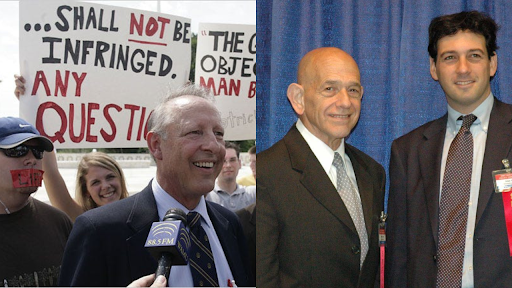
To challenge the District of Columbia’s gun regulations and argue for the individualistic interpretation of the Second Amendment, Levy and his team began by assembling a diverse group of plaintiffs who could file and represent the lawsuit efficiently. Levy himself would be personally financing the lawsuit and serving as co-counsel for the plaintiffs, the latter role being integral to the research element of the case. The diversity of Levy’s chosen plaintiffs mirrored the methods of Thurgood Marshall; however, whereas Marshall brought forth a diverse set of cases, Levy brought forth a diverse set of plaintiffs for his lone case. The rationale behind Levy’s method was to reinforce the individual application of the Second Amendment. With a group of six—split between three men and three women; both white and black; all with a personal stake in gun rights—Levy could efficiently argue the importance of the individual right to bear arms through the varying experiences that surrounded the plaintiffs’ vested interest in the lawsuit. The rudimentary logic was that a massive prohibition failed to recognize the fundamental civil liberties and individuality of the District’s population, thus bolstering an individualistic interpretation of the Second Amendment, and discrediting the constitutionality of the Firearm Control Regulations Act.
In February 2003, the six plaintiffs, backed by Levy, filed their lawsuit against the District of Columbia in the District Court for the District of Columbia. A year later, in March 2004, the District Court dismissed the lawsuit. The plaintiffs appealed this decision, which was then reversed in 2007 by the U.S. Court of Appeals for the D.C. Circuit. In reversing the District Court’s decision, the appeals court also nullified the Firearms Control Regulations Act, affirming the plaintiffs’ arguments of unconstitutionality. The court claimed that the Second Amendment applied to the individual right to bear arms, citing the historical context in which the Constitution was written. This context not only included the rights that preceded the Constitution itself, but also the purpose of these rights within the Constitution, which the court stated were the right to bear arms for self-defense and the prevention of tyranny. The appeals court also specified these claims regarding the Second Amendment’s commentary on militias, stating that the preservation of the citizens' militia was not founded on the collectivity or active service of the militia itself; rather, it was founded on the collective citizenry itself and their continued individual rights to bear arms. The appeals court concluded that all facets of the Firearms Control Regulations Act violated the Second Amendment right to bear arms—and the right to self-defense it entails—and therefore the law was unconstitutional. The appeals court, however, also found that Dick Anthony Heller was the only plaintiff of the six who had standing to sue the District. Heller was a special police officer who had been denied a handgun permit.
The District of Columbia appealed the reversal to the U.S. Supreme Court in 2007. On November 20th, 2007, the U.S. Supreme Court granted the District’s appeal a writ of certiorari. Oral arguments in the case boiled down to the aforementioned contemporary views on the Second Amendment. The defense, the District of Columbia, argued that gun rights, as explained in the Second Amendment, were solely militia-related. Walter E. Dellinger III of the defense stated, “When Madison introduced the amendment in the first Congress, he exactly equated the phrase ‘bearing arms’ with, quote, ‘rendering military service.’” Heller’s counsel, Levy, and attorney Alan Gura, along with several Supreme Court Justices, challenged this by noting the relationship between the first and second clauses of the Second Amendment is not a contradiction; the second clause, the individualistic clause of the amendment, exists for a reason. Justice Antonin Scalia explained this and elaborated on the opinion held by the appeals court, saying, “The two clauses go together beautifully: Since we need a militia, the right of the people to keep and bear arms shall not be infringed.” The logic in this argument is that the first clause is actually predicated on the second: the concept of the militia is comprised of the rights of the individuals who are at liberty to uphold and serve within it. Scalia, alongside Justices Roberts, Kennedy, Thomas, and Alito, upheld the appeals court’s decision and struck down the Firearms Control Regulations Act, declaring it unconstitutional. Justices Stevens, Souter, Ginsburg, and Breyer dissented in the 5-4 decision.
In Justice Stevens’ dissent, he argued that the Second Amendment is not as unlimited and adaptable as the majority claimed. He supported the rationale of the defense, believing that the historical context of the amendment is more literal and significant than the majority ruled. Stevens analyzed the amendment through other supporting documents from the U.S.’s founding, which held that the right to bear arms was entirely associated with militias and their role in the U.S. at that time; there was more specificity behind the “people,” he claimed, the right to bear arms had to serve a purpose, not just the arbitrary possibility of self-defense. Additionally, Stevens and the other dissenting Justices pointed to regulatory gun laws that predated the Constitution. They asserted that the legislature had always held control over the right to bear arms, even in the midst of militias. The dissenting opinion was one that expanded on the defense’s arguments, the belief that the original function of the Second Amendment had essentially been lost to time, and that in the modern U.S., the right to bear arms had been shifted from the legislature and militias to the legislature only.
District of Columbia v. Heller is widely viewed as one of the most controversial decisions in Supreme Court history; after all, gun control has been a topical and inflammatory topic in U.S. culture and politics for some time now. Following the decision, the NRA filed several lawsuits against other states and cities, intending to use the precedent that the Heller case set as a means to nullify additional gun control legislation. Critics of the decision point to impacts like these, and the process behind the decision itself, to assert that this case was politicized and that its decision marks the success of dangerous institutional circumvention: rather than vote for representation and legislation, Heller and counsel sought direct legislative reformation in court. The Second Amendment and the Constitution as a whole, however, are not inherently politicized, and while the Constitution may be politicized now, the Heller case is distinct because it lacked the fervor or blatant partisanship that is typically associated with gun control reformation. Robert A. Levy and the Cato Institute can be likened to idealists in this instance. Levy himself did not have any personal or vested interest in gun control; rather, he wished to pursue libertarian ideologies through means that are lauded as an exemplar for the judicial process—the processes and legal ideologies of Thurgood Marshall. Levy’s background and voiced motivations do not abscond him from political bias, but his outward presentation as a libertarian scholar places his motivations somewhat beyond the polarity of the current two-party system. District of Columbia v. Heller is not only relevant because of its decision regarding gun control, but also because it demonstrates a departure from traditional, idealistic approaches to liberty and justice. Several scholars within the past two decades have noted that U.S. politics and government no longer seem to hold opportunity for nuance or evolution. Libertarians at the Cato Institute would argue that, in recent years, all levels of government have increasingly encroached upon constitutional civil liberties without much scrutiny. The politically charged nature of the Heller case and its evolution from scholarly examination to controversial precedent suggest that both government and populace have turned away from structure and institution, instead favoring polarized topics that are significant as long as they remain in flux. Despite its controversy, District of Columbia v. Heller marked itself as an ideological bastion, a representation of evolutionary discourse that the Constitution itself encourages.
Reid Beatty is a freshman majoring in political science.
Sources
Adam Liptak, Carefully Plotted Course Propels Gun Case to Top, N.Y. Times (Dec. 3, 2007), https://www.nytimes.com/2007/12/03/us/03bar.html.
Audrey Grayson, A Legacy of Liberty: Robert Levy Leaves His Mark on Libertarianism, Free Soc’y (Cato Inst., Summer 2024), https://www.cato.org/free-society/summer-2024/legacy-liberty-robert-levy-leaves-mark-libertarianism.
Brian Duignan, District of Columbia v. Heller, Encyclopaedia Britannica, https://www.britannica.com/event/District-of-Columbia-v-Heller (last visited Mar. 4, 2026).
District of Columbia v. Heller, Oyez, https://www.oyez.org/cases/2007/07-290 (last visited Mar. 4, 2026).
District of Columbia v. Heller, 554 U.S. 570 (2008).
Mission, Vision, and Principles, Cato Inst., https://www.cato.org/about/mission-vision-principles (last visited Mar. 4, 2026).
United States v. Miller, 307 U.S. 174 (1939).
