
ANTIFA a "DTO"? The Legality of Declaring Domestic Terror Organizations
By Wyatt Smith ‘26
On September 22nd, 2025, President Trump signed an executive order titled “Designating ANTIFA as a Domestic Terror Organization.” The order begins by defining ANTIFA as “...a militarist, anarchist enterprise that explicitly calls for the overthrow of the United States Government, law enforcement authorities, and system of law” before detailing the alleged illicit activities of ANTIFA; these include politically motivated violence, doxing, coordinated attacks against law enforcement, and unlawful suppression of political activity. The president then proceeds to declare in the order that “All relevant executive departments and agencies shall utilize all applicable authorities to investigate, disrupt, and dismantle any and all illegal operations…” with respect to ANTIFA. The order concludes with a provision specifying that it does not purport to create any substantive law, and shall be implemented in accordance with extant United States law. Three days later, President Trump issued National Security Presidential Memorandum 7, instructing relevant agencies of the executive to go after domestic terror and organized political violence in the U.S. This begs the question: what does this executive order actually mean, both for alleged members of ANTIFA, and for the government of the United States?
Defining ANTIFA
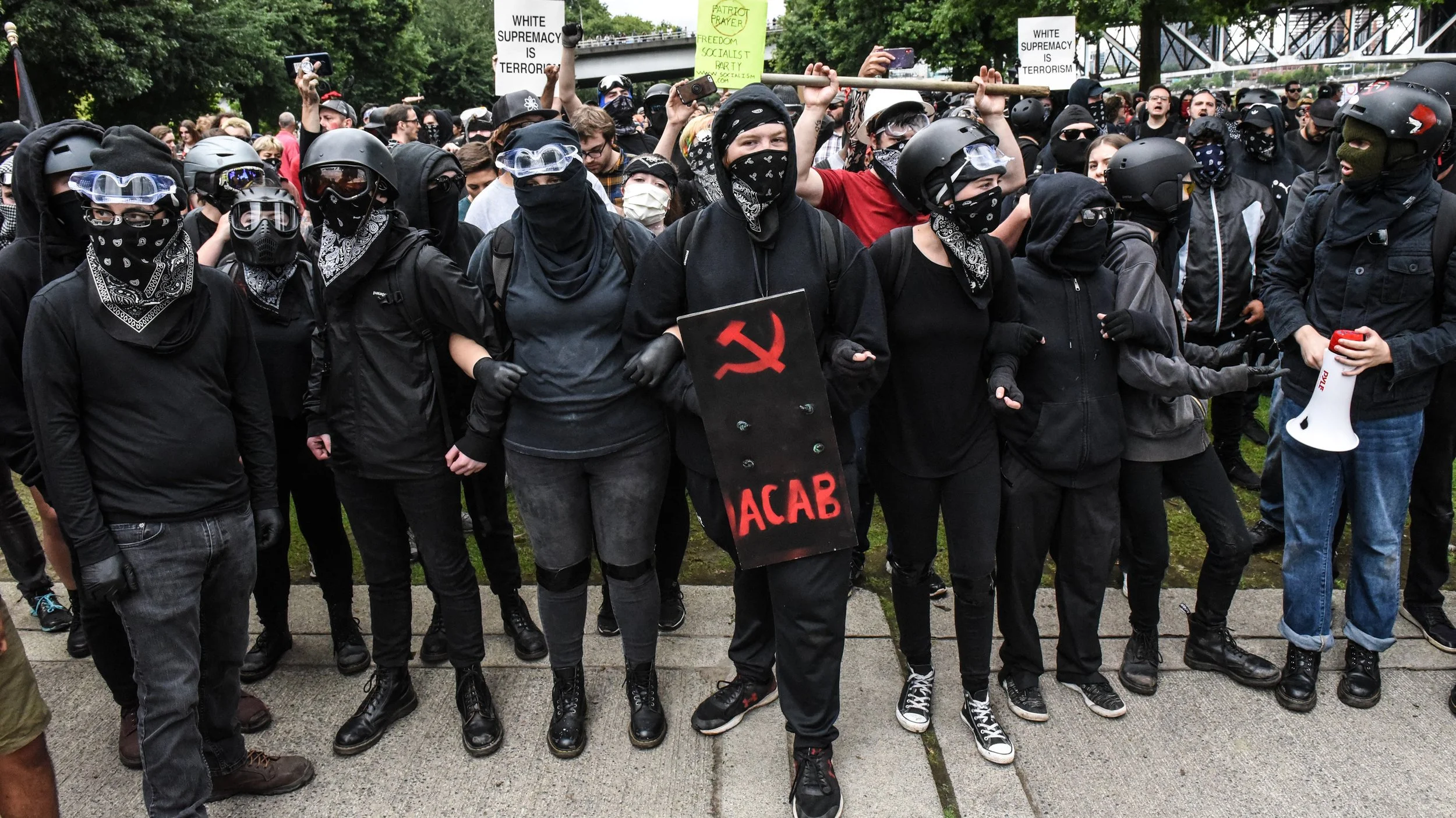
Before we proceed to dissect the legal implications of Trump’s September executive order, it is important to define what exactly ANTIFA is. According to the Congressional Research Service, ANTIFA is a loose and broadly disorganized collective of like minded, mostly left-aligned individuals who organize periodically to counter what they perceive as fascist activity. Many participants in this movement view themselves as the spiritual successors of a protest tradition dating back to the rise of fascism in Europe during the 1930s. ANTIFA has no membership, roster, or central organized structure per se; instead, they typically organize locally, and on a contingency basis.
As of now, there does not appear to be any credible evidence to suggest that ANTIFA is funded or financially backed from some central node. However, President Trump has signaled that he wants the government to take a closer look at potential sources of funding for ANTIFA. The president has stated multiple times that he believes ANTIFA to be funded by powerful investors; proving that the group has a central source of financial backing could open the door to escalation by the government. Establishing a central structure and source of funding for ANTIFA could facilitate the use of the Racketeer Influenced and Corrupt Organizations (RICO) Act against them, a federal law which gives the government an enhanced toolkit for fighting organized crime, something that Trump has expressed interest in.
The Current Framework Governing Terrorist Designation in the United States
As it currently stands, there is not a formal or legally operative process in United States law for designating a domestic terror organization. Instead, what the government can do is designate a foreign terrorist organization, or FTO. The power to do this was delegated to the Secretary of State by an amendment to the Immigration and Nationality Act in 1996. An organization can be designated as such if their activities threaten U.S. nationals or the national defense, as well as interfering negatively with the foreign and economic interests of the U.S. Once an organization is designated as an FTO, the government gains access to a powerful set of tools to go after them; these include asset freezing, the criminalization of material support towards the group, and restrictions on immigration. Importantly, an organization being an FTO does not automatically enable the use of military force against suspected members.
Organizations such as ISIL, Al-Qaeda, and Boko Haram have been designated as FTOs in the past, which has allowed the U.S. government to target their assets and impose powerful measures to strangle them financially and cut them off from support. More recently, several Mexican cartels, MS-13, and the Venezuelan gang, Tren de Aragua, have been designated as FTOs. In order to be designated as an FTO, an organization must:
Be foreign;
Engage in terrorist activity as defined in 8 USC § 1182(a)(3);
That terrorist activity must threaten the U.S. or American interests.
Since ANTIFA is a domestic movement, it does not meet the first prong required for designation as an FTO. Additionally, the designation of ANTIFA as an organization is questionable in and of itself, since it ostensibly lacks a roster, treasury, leadership, and many other hallmarks of an organized group.
As for the possibility of creating a DTO or Domestic Terror Organization designation under law, there are some serious legal barriers that the government is unlikely to be able to clear. For one, the First Amendment has long been interpreted by the Supreme Court to provide an implicit freedom of association, which would raise the bar for identifying a domestic group as a terror organization, and for taking action against their members on the basis of association.
Additionally, several Supreme Court cases have reinforced that freedom of association, including 1958 case NAACP v. Patterson, wherein the Supreme Court unanimously ruled on First Amendment grounds that the NAACP did not have to turn over a membership list to the State of Alabama. Patterson set the bar very high for government entities seeking to take legal action solely on the basis of association. The 1972 case United States v. United States District Court further clarified that the government could not make use of wiretapping against citizens absent a warrant, even in the context of national security threats; this case suggests that criminal procedure is not expedited for the government just because the alleged criminal is engaging in subversive activity. The government must still follow standard procedure when prosecuting political dissidents. Finally, NAACP v. Claiborne Hardware Co. saw the NAACP’s leadership sued over violent acts by a few of their members; the Supreme Court ruled that political organizations or individuals cannot be held liable for crimes perpetrated by members with whom they associate, absent a proven criminal conspiracy. That is, if an alleged member of ANTIFA in Portland assaulted someone, another unrelated individual in Seattle who associates with that ideology could not be held liable by association.
Can the president then create a new designation for “DTOs” independently? Likely not; this executive order, as noted in the order itself, does not create any new law. The 1952 Supreme Court case Youngstown Sheet & Tube Co. v. Sawyer makes it clear that “the President's power to see that the laws are faithfully executed refutes the idea that he is to be a lawmaker.” Youngstown established a tripartite framework for evaluating the legal grounding of presidential actions, with each successive category being weaker in legal standing than the last:
When the president acts with the express or implied authorization of Congress;
When the president acts in either the absence of congressional grant or denial of authority;
When the president acts against the express or implied will of Congress.
The attempt to unilaterally create a “DTO” designation would likely fall into the third category of the Youngstown test, and would lack legal standing since the power to make laws is vested in Congress.
Implications for “ANTIFA” and for the U.S. Government
If ANTIFA can’t be designated as an FTO, and the possibility of creating a (currently nonexistent) “DTO” designation is slim, then what exactly do Trump’s executive order and NSPM 7 mean? Put simply, the executive order designating ANTIFA as a domestic terror organization and the corresponding National Security Presidential Memorandum should be interpreted as statements of policy.
On the surface, these instructions to the executive can be seen as a recommendation for how to allocate resources. The Justice Department and executive branch as a whole have a limited number of resources, and the president is instructing them to prioritize cases that may target ANTIFA and its alleged members, since the president and his administration view them as a serious national security threat.
Going a bit deeper, President Trump and his cabinet routinely make reference to ANTIFA’s source of funding, which signals that they may be trying to find evidence that ANTIFA is a centralized organization as opposed to a movement. Such a revelation would potentially, but limitedly, expand the government's ability to prosecute ANTIFA. If the government can tie ANTIFA to an organized criminal enterprise, then the government may be able to make use of RICO charges against its members; President Trump has referred to discussions with U.S. Attorney General Pam Bondi, indicating that he would like to do exactly that, treating ANTIFA as an organized criminal enterprise akin to the mafia.
If ANTIFA could be established as a criminal enterprise, and subsequently tied to a pattern of racketeering or organized criminal activity, they could potentially be charged as a network. Establishing a source of funding would be central to proving that “enterprise” part. Of course, this approach still faces tempestuous legal headwinds.
While 2009 Supreme Court case Boyle v. United States allows for a broad interpretation of “enterprise” in RICO proceedings, allowing some room for inference by the jury, this interpretation still sets a bar that ANTIFA is unlikely to clear due to their decentralized nature. Claiborne undermines the notion of guilt-by-association further, especially in a political context, and especially when the decentralized nature of ANTIFA is once again taken into consideration. The Supreme Court Case Scheidler v. National Organization for Women, decided in 2003, further denigrates the argument that RICO can be used against groups of political dissidents. In Scheidler, groups of anti-abortion protestors were accused of engaging in a broad criminal conspiracy to shut down legal abortion clinics. The Supreme Court ruled 8-1 that RICO did not apply, even though Chief Justice Rehnquist noted that individual actors were engaging in acts of coercion. The same logic may be applied to ANTIFA, unless the government can prove that they quite literally operate like the mob.
Conclusion
For the U.S. government, and for ANTIFA, this series of events should be interpreted as directional and rhetorical, as opposed to legally operative, or definitive in any way. While the executive order does “designate” ANTIFA as a domestic terror organization, there is no such designation under U.S. law, and that designation should be taken with a grain of salt, particularly considering the precedent set in Youngstown. This set of statements by President Trump are both sharp rhetoric, and a declaration that the government will prosecute ANTIFA to the fullest extent of the law, even if the law doesn’t extend so far as to allow the use of RICO in this case. The executive cannot unilaterally declare an organization a domestic terror organization in any legally meaningful way, but it can direct its resources towards what it perceives to be their best use in the executive’s primary directive: enforcing U.S. law.
Wyatt Smith is a senior majoring in operations and supply chain management.
Sources
Boyle v. United States. (n.d.). Oyez. Retrieved November 2, 2025, from https://www.oyez.org/cases/2008/07-1309
Brandenburg v. Ohio. (n.d.). Oyez. Retrieved November 2, 2025, from https://www.oyez.org/cases/1968/492
Briceño, M. (September 19, 2025). Trump wants to designate antifa as ‘a major terrorist organization.’ Can he do that? PBS. https://www.pbs.org/newshour/politics/trump-wants-to-designate-antifa-as-a-major-terrorist-organization-can-he-do-that
Bureau of Counterterrorism. (n.d). Foreign Terrorist Organizations. State.gov
Retrieved November 1, 2025 from
https://www.state.gov/foreign-terrorist-organizations/
National Association for the Advancement of Colored People v. Claiborne Hardware Company. (n.d.). Oyez. Retrieved November 2, 2025, from
https://www.oyez.org/cases/1981/81-202
National Association for the Advancement of Colored People v. Patterson. (n.d.). Oyez. Retrieved November 2, 2025, from
https://www.oyez.org/cases/1957/91
Olmsted, E. (August 27, 2025). Trump Threatens RICO Charges Against George Soros. The New Republic.
https://newrepublic.com/post/199676/trump-threat-rico-charges-republicans-favorite-bogeyman-soros
Patel, F. (October 9, 2025). Trump’s Orders Targeting Anti-Fascism Aim to Criminalize Opposition. Brennan Center for Justice.
Racketeer Influenced and Corrupt Organizations Act, 18 U.S.C. § 1961–1968. (1970)
Saco, L. N. (July 9, 2020). Are Antifa Members Domestic Terrorists? Background on Antifa and Federal Classification of Their Actions. Congressional Research Service.
https://www.congress.gov/crs-product/IF10839
Saco, L. N. (December 19, 2023). Understanding and Conceptualizing Domestic Terrorism: Issues for Congress. Congressional Research Service.
https://www.congress.gov/crs-product/R47885
United States v. United States District Court for the Eastern District of Michigan. (n.d.). Oyez. Retrieved November 2, 2025, from
https://www.oyez.org/cases/1971/70-153
White House. (2025, September 25). Countering Domestic Terrorism and Organized Political Violence (Presidential Memorandum). https://www.whitehouse.gov/presidential-actions/2025/09/countering-domestic-terrorism-and-organized-political-violence/
White House. (2025, September 22). Designating Antifa as a domestic terrorist organization (Exec. Order). https://www.whitehouse.gov/presidential-actions/2025/09/designating-antifa-as-a-domestic-terrorist-organization/
Woodward, A. (September 17, 2025). DOJ says Trump protesters could face RICO charges for yelling at him while he was ‘trying to enjoy dinner’. The Independent.
Youngstown Sheet & Tube Company v. Sawyer. (n.d.). Oyez. Retrieved November 2, 2025, from https://www.oyez.org/cases/1940-1955/343us579
Yousef, O. (September 22, 2025). Trump has designated 'antifa' a terrorist group. Here are the questions that raises. NPR.
https://www.npr.org/2025/09/19/nx-s1-5545764/trump-antifa-domestic-terrorist-organization
